Summer musings: A year after the pandemic…

Last year in August, I was baking banana bread and writing haikus and picking sunflowers at a nearby farm. I remember feeling more relaxed even with all that was going on because of the COVID-19 pandemic. The time spent at home in spring 2020 helped me to take a step back, slow down and relish the moment. Yes, I confess I did some binge watching of Netflix movies and had moments of panic. But more often than not, I felt an inner peace and calm especially in my times of inward reflection and prayer. I noticed little things that I hadn’t paid attention to before: the rising and falling of my chest while I was meditating, the distant sound of an owl “whooo-ing,” and the swaying of the bamboo when a strong breeze swept through our neighbor’s backyard.

A year after, the pandemic hasn’t ended, but my more relaxed state of mind and heart seems to be waning. I have lapsed into my pre-pandemic mode of being that is addicted to hurry, obsessed with productivity and unwilling to slow down. For the first time in over ten years I have decided not to take the last two Sundays of August off. This decision, in retrospect, was a mistake.

So here I am writing and reflecting on what of this summertime I can still salvage. Perhaps, I can still make a day trip to the mountains or near a lake and get away from it all: the 24-hour news cycle, social media and all the online cacophony of opinions, claims, disinformation and the raging battle over masks and vaccines. It may not be too late to celebrate this season, even with its heat waves, tornadoes and forest fires. I still have time to listen to the crickets, watch the fireflies glow at dusk and take a much needed afternoon nap.

Perhaps, I can still make a day trip to the mountains or near a lake and get away from it all… (free photo from pexel.com)


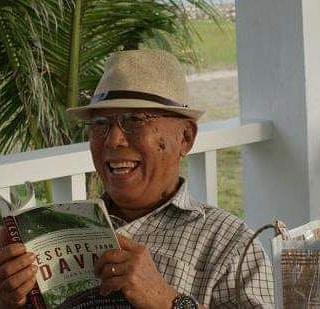
Dad’s Stories

No one else will tell Dad’s stories –

of carabaos fighting,

he, surviving

caught in between locked horns.

… a pot of rice

rolling down the hill,

cooked, caked

rice escaping,

Japanese soldiers laughing,

one life spared,

the tragicomedy

of war.

…trekking up

the mountains of Maasin

with a few worldly goods

and St. Teresa of Avila’s bust

wrapped in a cloth.

No one else will tell Dad’s stories

Unless I do

to a new generation of survivors

in this fighting, divided world.

I have to tell Dad’s stories!

They are Dad’s whispers

of hope.

Study Notes on the Gospel of John

In my view, the gospel writer, John writes in a manner that reflects the concept of “thin places.”  Thin places means a place where God is present in a deep and meaningful way.  This means they could be anywhere. But they can also mean special spaces where heaven and earth meet – or at least have a flimsy boundary that allows for the divine and human to go back and forth.  For John, the prologue is like a thin place where heaven and earth meet in Jesus (1:14-18).  Jesus, is the divine-human messenger who is presented as the Logos (Word) and Light who reveals God as Father.  In the first four verses of John 1, the reader is swept into a cosmic stage where he or she reads about Jesus, the Word before any word was spoken and the Co-creator of the Universe (1:3-4). This is Jesus who was before time and creation began. This is Jesus who is not from our planet and dimension. But because of a powerful force called LOVE (1:18; 3:16) came to our planet to reveal who God is – the God who he calls Father.  John begins his story about Jesus by telling the reader/audience that the person I am about to introduce to you is no ordinary being but someone who is going to change your life if you believe in him. (Another example of “thin places” encounters in the Bible are Moses meeting God in the burning bush (Exodus 3) and Jesus transfigured on the mountain. John alludes to it in John 1:14 and the Synoptic Gospels report with more detail (Matthew 17:1-8; Mark 9:2-8; and Luke 9:28-36).

Jesus, the Logos made human, who was the Word/Message and the Messenger who showed up and pitched his tent among humans not just to save them but to inspire them to live empowered by the Light, who shines in the midst of darkness.  It will be helpful to the 21st century reader to know that John’s reference to “the Jews,” does not mean all Jewish people.  “The Jews” in John’s Gospel are the Jewish religious leaders and those who rejected Jesus as God’s Son.  John’s Gospel must not be used to incite anti-Jewish sentiments. John is making a differentiation between the Jews who believed and those who did not believe (cf. John 8:31-32).  John’s Gospel included a promise of eternal life for whoever (Jews and non-Jews) believed in God’s Son (John 3:16) because of God’s love.

Prayer – Awe

  1. I open my eyes from slumber and see the sunbeams softly fill the room with light. I breathe deeply, aware that once again, I am alive, reborn and renewed by you, O Loving Creator who watched over me while I slept last night.
Thank you. Thank you. Thank you. Let me not forget this quiet moments of gratitude and awe in your holy presence. Let me go through this day with eyes wide open, ready to be in awe of the beauty and goodness in me and around me today. Let me be in awe of what goes unnoticed, a leaf, a fallen branch, a bud waiting to flower...and by your grace, in these moments, let me feel your presence, take me by the hand. In the name of Yeshua, who calmed the storm and fed the hungry multitude. Amen.